Friday, 13 March 2015
Yes, I agree with Nick (mostly)
No, you didn't misread the headline. Nick Clegg has made some big mistakes, and I've not been afraid to criticise him, be it the tuition fee pledge/vote or the increase in VAT. However, if anything my opinion of him has improved recently, and I have a new-found sense of respect for him.
I'll be frank in saying that after our crushing losses as a party in May 2014 (the local and European elections), I was tempted to call for Clegg to go. Our party base appeared to be eroding faster and faster, with little electoral reward in return. Such a move would have been a knee-jerk reaction, especially when you consider the wider context (which we as a general public don't always do). For starters, in 2010 there was no popular alternative option to take. A coalition with Labour? The numbers didn't add up for a start, a multi-party coalition including the likes of Plaid Cymru and the SNP would have been needed (sound familiar?), and do you really like the thought of Gordon Brown plodding on as Prime Minister? Even if a leadership election had been held, there would have been a good couple of months of an 'interim Prime Minister', and when the leadership election concluded we'd have had another Prime Minister who hadn't had an electoral mandate. Furthermore, documented accounts from the likes of Andrew Rawnsley (The End of the Party) and Adam Boulton (Hung Together) make it quite clear that Labour didn't really fancy doing a deal, as the latter notes:
"At least half the Labour side, and the dominant, elected side at that - Harman, Balls and Miliband - did not have their hearts set on reaching a deal" (p.233).
The point of this illustration is that Labour accusations of "selling out" to the Tories appear strange when Labour weren't keen on a deal either. So how about another option; go with no one? We could have trumpeted the 'principled' line for a while, but we'd never be seen as a potential party of government. A minority Tory government would have struggled along until a second election, where they most likely would have won a majority. Would we get praise for letting that happen? I sincerely doubt it.
Clegg made key errors in the early stages of this Parliament. You could understand him wanting to show the Coalition working, but he appeared too close to David Cameron, and was too naive to think that the Conservatives wouldn't get heavily involved in campaigning against the Alternative Vote (the Labour Party hardly helped, either). However, he deserves far more credit than he is getting. In 2012 he publicly made an apology for the tuition fee fiasco. This may sound a little pathetic on paper, but how often do politicians actually apologise for a specific policy error? Furthermore, despite Ed Miliband's bravado about David Cameron running scared of the TV debates (which he is, nevertheless), Nick Clegg was the only leader with the guts to take on Nigel Farage during the European elections, and it was Clegg who made the challenge in the first place. We've been reduced to 1 MEP, but I'm proud that we had a positive message for staying in the EU, rather than a bitter infighting Tory brand or a fence-sitting Labour pledge. Clegg also takes a weekly radio phone in on LBC radio, which again should not be understated. Could you imagine David Cameron doing that? Or Ed Miliband?
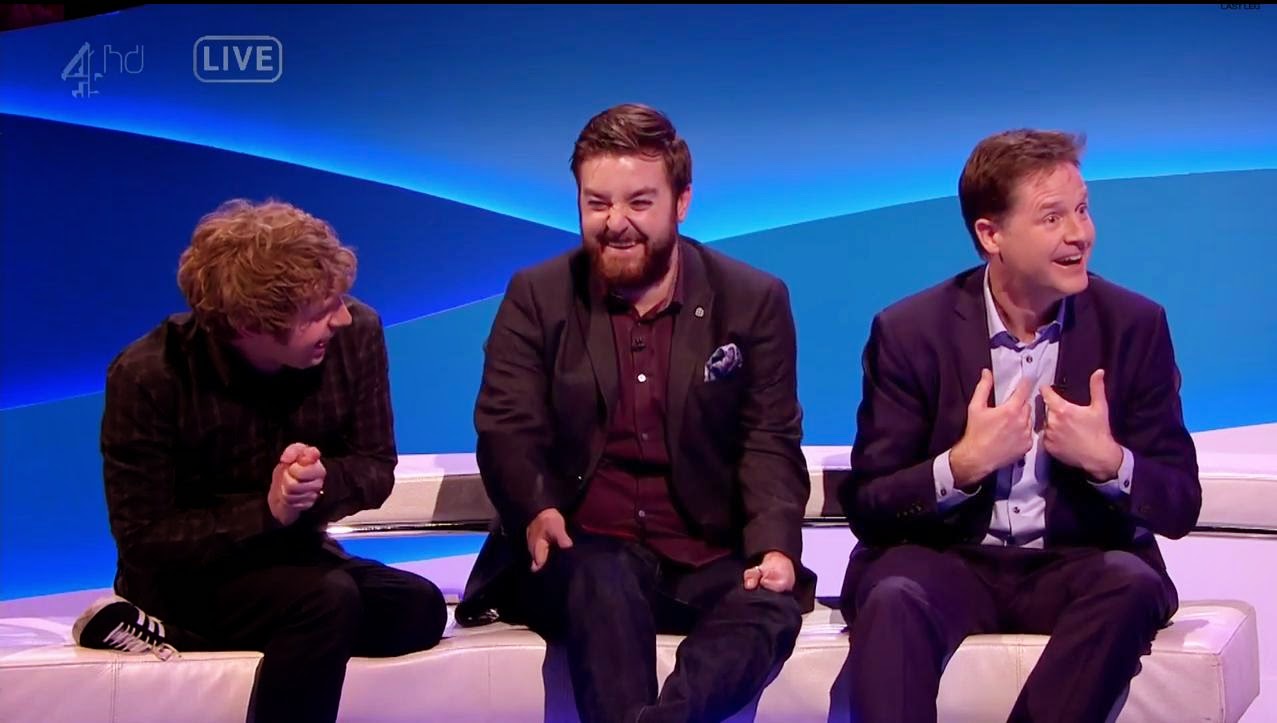
Nick Clegg was also a sport for going on the comedy programme "The Last Leg", where "the unthinkable happened" (in the words of host Adam Hills) and Nick Clegg "did well. Really well. I mean, really, really well". When Clegg was challenged to provide Alex Brooker with a solid reason for voting, he pulled out this humorous yet brilliant analogy: “if you go to Nando’s and get someone else to go up to the counter and order for you, you can’t complain if they come back with a meal you don’t want.” Once again, can you picture Cameron or Miliband going on the show? I'll extend it further and ask if you could possibly imagine Natalie Bennett appearing comfortable in the studio? I've not forgotten Farage, but for all his confidence I can't imagine him winning anyone over.
Nick Clegg call for pluralism when he was first elected Liberal Democrat leader in 2007, and he should be admired for tackling petty tribalism. If the Labour Party failed to form the next government but were able to take Sheffield Hallam off Nick Clegg, you can imagine that they'd celebrate like they'd won a landslide. Clegg should also be commended for the (broad) stability of government. How many people, especially on the Left, predicted the downfall of the Coalition in the early years? Even the more generous commentators presumed that it would break up in 2014 or early 2015, yet here we are. For the sake of the economy and the markets, it is a good thing that we'd had a government with a comfortable (combined) majority for a fixed-term Parliament.
It's popular to caricature and bash Clegg, but the people who do so rarely come up with a plausible or realistic alternative. Again, the dissenting voices on the Left would do well to expect a Green Party predicted to have 1 to 3 (at best) MPs to turn around and demand that the largest party in May reverse all economic cuts, bring in a Citizen's Income which would cost more than twice the NHS budget and aim for a zero-growth economy. The reasons for hating Clegg are often clichéd, too; "he broke his promise on tuition fees". Implicit in that is that you should hate Clegg for breaking a promise; using this logic, you should hate pretty much every politician (which I'm sure many do, but Clegg seems to bear the brunt of most of it). How about another one: "he sold out to the Tories". I'm pretty sure that getting the main policies from the front page of your manifesto into government for the first time in generations isn't selling out. I'm no lovestruck cheerleader for Nick Clegg, but I'm not ashamed to give him credit where it is due, and he is due a lot of it.
Wednesday, 4 February 2015
Stephen Fry doesn't believe in an "evil, capricious, monstrous" God. Well, neither do I
Let me be clear on this, I do very much like Stephen Fry. He's a fiercely intelligent person, has fought for worthy causes and is a brilliant host of QI. His quick wit was portrayed brilliantly by his quote about Piers Morgan (I'll leave you to search for that one). However, I was disappointed (though not surprised) by his response to the question of how he'd greet God in heaven: "Why should I respect a capricious, mean-minded, stupid God who creates a world that is so full of injustice and pain? That’s what I would say". He misses the point and casually misrepresents the Christian faith in one stroke.
There's no doubt that people of faith are often on the back foot. It's far easier for an atheist to have a snappy soundbite and to win rounds of applause in a Question Time-style debating format. It's easy to view the New Atheist position as a comfort zone, and there are many notable proponents of it, such as Richard Dawkins and the aforementioned Fry. However, the New Atheist position is often under-examined. Andy Walton makes some very astute observations in his article here: https://www.blogger.com/blogger.g?blogID=8247030988354974455#editor/target=post;postID=6809322646091019382
He notes the ignorance of the atheist bus campaign spearheaded by Richard Dawkins (who later admitted that he wanted to reword the slogan), which noted there's "probably no God", so "stop worrying and enjoy your life"; Walton points out that sufferers of brutal regimes in North Korea and similar places, who cling to the hope of the resurrection, can hardly live by the maxim of that bus campaign.
It's easy to get into all sorts of arguments about faith, and the faith versus atheist debate is very much a hot potato. However, let's get back to Stephen Fry. The point he made, whilst worded provocatively, is always a tough question to battle as a Christian, and often repeated; why allow suffering? I remember a Christian Union speaker dealing with this question back in 2012 brilliantly. In short, the speaker noted that a world without God would still have suffering and pain, only that kind of world wouldn't have a rhyme or reason for it. There would still be awful cases of injustice and suffering, only it'd be a "hard luck" scenario, with no hope of ultimate justice. As another CU speaker noted last year, we also make a philosophical error if we assume that a perfect world, made via the 'click of the fingers' approach which atheists often chide God about, would include us in it.
I confess (no pun intended) that the above summary wasn't particularly eloquent, but I feel that John C. Lennox's "Gunning for God: Why the New Atheists are missing the target" tackles these kind of thorny issues brilliantly. He sums up a counter point to Fry well in the book: "God could have removed the potential for hatred and evil at a stroke by creating us as automata, mere machines doing only that which we were programmed to do. But that would have been to remove all that we ourselves value as constituting our essential humanity...We would not wish our children to be degraded to machines. Nor will God similarly degrade human beings" (p.148). That doesn't sound like a God who is "evil" and "monstrous" to me.
I couldn't help but ask for Peter Hitchen's point of view on this (and he was a sport for replying). I share theological, not ideological, convictions with him (some would argue that the two are indistinguishable, but that's for another day).

Naturally, there were some responses to him on this, and he made another dry (but still humorous) response:
Some people on my side of the political spectrum may recoil in horror at the thought of me agreeing with Peter Hitchens on something, but that's the beauty of fellowship and a shared goal. Conversely, I share some political opinions with Stephen Fry (and noted atheist Dr Evan Harris is a Liberal Democrat), but obviously we differ on belief. I can't truly do the Christian side of the argument justice, and it's certainly a good sermon topic. However, I can't think of a better story to counter Stephen Fry's accusations than the Easter story; that of God coming to Earth in human form and being made to be the lowest of the low and crucified, for the sake of those who despise(d) Him.
Thursday, 29 January 2015
What is the Government doing to help young people in the Dales stay local?
It says something about our MP that even the leader of the Derbyshire Dales District Council, the Conservative Lewis Rose OBE, objects to an ill-considered government measure on affordable housing. A new threshold for central government planning (around 10 units or less) was announced on the 28th November, meaning that developers will have far less of an obligation to provide affordable housing across the district.
A recent Guardian article (found here: http://www.theguardian.com/society/2015/jan/13/affordable-rural-housing-new-threat) highlights how the reforms listed on the DDDC website will hurt the Dales (http://www.derbyshiredales.gov.uk/your-council/news-and-publications/latest-news/1849-policy-reforms-to-hit-future-affordable-housing-provision). I'll give credit to Lewis Rose for not simply toeing the party line. Indeed, if his quotes were ascribed to opposition leaders you wouldn't question the source: "they torpedoed our scheme (£1.2 million over 10 years to deliver more than 1,000 homes) at a stroke by an arbitrary change to planning rules...It came out of the blue. It meant that our whole affordable housing strategy was severely damaged. I was appalled".
The topic of affordable housing is a serious issue across the whole country, but in the Dales this comes back to a point I made when I was first selected as the Parliamentary Candidate for the Liberal Democrats; the area may superficially have an affluent image, but the reality is quite different. As a young person myself, affordable housing certainly seems a long way off, and I think I can say that the feeling is mutual for many young people across the area.
Some more credit to Lewis, as he has questioned Patrick McLoughlin on the issue, who was "taken aback because he realises the seriousness of the matter". The Guardian article notes that Patrick will be looking into it, but somehow I doubt that the status quo will be challenged. The Derbyshire Dales is a beautiful part of the world to live in, but I don't want it to be exclusive to a minority, or too expensive for the majority. The Dales is for young people, too.
Thursday, 8 January 2015
The NHS needs consensus, not weaponry
Along with the economy, the NHS is rightly seen as a top priority by the population of Britain. Simon Jenkins notes in Thatcher and Sons that even the Queen of privatisation, Mrs Thatcher, was “terrified” of touching the NHS. It’s a behemoth that politicians must pay lip service to, and any slight tampering is met with outcries. The controversial Health and Social Care Act of 2012 had to be “paused” after significant opposition, and is still viewed with suspicion today. Nevertheless, I am encouraged that, despite the tough economic decisions that have been made in this Parliament (and will continue to be made after 2015), the major parties have already pledged significant sums of money for the NHS post-2015. The Autumn Statement secured an extra £2bn of funding, and the Conservatives, Labour Party and Liberal Democrats all appear eager to meet the extra £8bn per year target by 2020, as set out in Simon Stevens’ Report (NHS Chief Executive). What is less encouraging is the political posturing that has taken place.
The recent A&E crisis is a serious concern, and it further underlines how vital extra cash is to the health service. However, Jane Merrick was right to point out in The Independent that “trying to profit from NHS misery” is cynical and unhelpful. She points out that Jeremy Hunt plays down problems in the NHS, whilst friends of Ed Miliband have noted that he wants to “weaponise” the NHS as an election issue. Each political party no doubt will argue in the coming months that it is best placed to handle the NHS, but as the health service is stretched and the A&E crisis escalates, patients and families who are affected do not need politicians utilising the crisis as an election tool, nor do they need triumphalism when the NHS enters calmer waters.
As crazy as this may sound to some voters, it’s also tricky to see the NHS argument as black and white. I have had many emails from constituents in the Derbyshire Dales asking whether I’d support a proposed ‘NHS Reinstatement Bill’, which would “reverse 25 years of marketisation in the National Health Service, abolish the purchaser-provider split, re-establish District Health Authorities and other public bodies and fully restore the NHS in England as an accountable public service”. I am sympathetic to this, and I do not like the idea of market principles creeping further into the NHS. I was very sceptical of the aforementioned Act of 2012, but I am pleased that the distinction of the NHS remaining “free at the point of use” has remained, and that the mandate is still there for the Health Secretary to provide such a service. I have offered broad support for the NHS Reinstatement Bill on the condition that other distinctions are clarified. I admit that this is not an unequivocal stance, but private involvement that is controlled and that can reduce waiting times and benefit patients is a good thing. Furthermore, as a Liberal Democrat I know the lesson of this Parliament of not making pledges that you can’t guarantee in the future.
I am set to take part in an NHS debate in March with my political opponents, and I very much hope that we attempt to reach a consensus on what is best for the NHS in the Derbyshire Dales, rather than having a slanging match which will benefit no one. The NHS should always remain free at the point of use, and as Jane Merrick puts it, “ministers and opposition politicians need to acknowledge that this crisis is a national emergency and try to reach consensus”.
Monday, 22 December 2014
Hopes (and fears) for 2015
The relatively short period of time between now and the 2015 General Election on May 7th was highlighted when the election campaign officially began on Friday 19th December. Polling day is just over four months away, and nobody can decisively predict the outcome.
I recently looked back at my 2011 prediction for 2015 (I did write back then that it was relatively premature to hazard a guess!): http://viewsfromthecentre-left.blogspot.co.uk/2011/10/2015-general-election-whos-going-to-win.html
It is clear that, over time, I have needed to significantly alter my estimate. I predicted a “comfortable, but not emphatic majority for Labour in 2015”, whilst wary that “events can change dramatically”. I also pondered the question “can victory be achieved under Ed Miliband?” The “comfortable, but not emphatic” victory is no longer my opinion, as the election is genuinely too close to call. Nevertheless, my questions for Ed Miliband remain the same today, that he “needs to present to the country a coherent strategy on dealing with the economy, but crucially he also needs to define what the Labour party are now”. Have these questions been answered? Put it this way; can you succinctly sum up Labour’s economic strategy? I certainly can’t. In terms of Labour’s identity, we’ve had Old Labour, New Labour, Blue Labour, predistribution Labour, One Nation Labour, with the latter three labels emerging within this Parliament! I also said that draining Liberal Democrat support wouldn’t be enough, and that appears to remain the case now.
I noted that the Conservatives needed an increase in growth and employment along with justification for their deficit reduction strategy to win in 2015. The Coalition has certainly delivered on the former; at the time of my October 2011 blog entry, 2.68 million people were unemployed compared to 1.96 million in October of this year, whilst UK growth returned to pre-recession levels in the second quarter of this year. However, with regards to justification for the deficit approach, the jury is still out; it has forced Labour to balance between renewal and ‘tough talk’ on spending cuts, but it also stands in a bad light in comparison to George Osborne’s original pledge to eliminate the deficit by 2015 (2018 is now the target). The Conservatives’ temptations to crudely imitate Ukip are well documented, and in Douglas Carswell and Mark Reckless they have already suffered defections to Nigel Farage’s party.
The challenges for the Liberal Democrats that I listed back in 2011 remain the same, that they need to shake off consistent unpopularity and receive justification for what they have achieved in the Coalition. Tuition fees are still used as a stick to beat the party with, but when you look at the context of 2010 and the record number of students in the present day, it doesn’t have to be as daunting an issue to face as it seems. On a local and personal level, I need to do my best to be a credible candidate for the Derbyshire Dales, to not only hold the Rt Hon. Patrick McLoughlin MP to account, but to also challenge the duopoly of Labour at County Council level and the Tories at District Council level. On a national level, I’m desperate to see the party raise the income tax threshold further. The personal allowance level will hit £10,600 in April, and with a Lib Dem presence in government it will rise to £12,500 over the next Parliament, with National Insurance thresholds aligned.
Interestingly, I made only one reference to Ukip in my 2011 blog predictions, which says much about how quickly and significantly they have barged into national politics over the last couple of years. This reference, nevertheless, holds true for 2015, although the ‘big three’ tag doesn’t apply anymore, as I noted “it is virtually impossible for other political parties to be in the running for the country in 2015, but they can all play an important role as the ‘big three’ try to win...UKIP can exploit strong anti-Europe sentiment and drain Tory support, whilst the Green Party can build on their 2010 success...as the ‘radical’ party”. Add the SNP to the mix to “damage the credibility of Labour”, and you have multi-party politics in action in 2015, and slim chances of having an overall majority. However well the likes of Ukip and company do in 2015, they are unlikely to have a fair reflection of seats from votes, so it is my hope (as ever) that electoral reform is back on the agenda post-2015.
Much has changed since late 2011, but whilst I have changed my overall prediction, the challenges listed for each party back then still apply, although fresh challenges have since emerged. My view now is that the performance of the party leaders in the spring of 2015 will shape the outcome of the election, with the TV debates once again key (rumoured to be in a 2-3-5 party format). For now, I predict a hung parliament, but I can’t guess who the largest party will be, nor can a multi-party coalition be ruled out.
Hopes for 2015
-Recognition of Liberal Democrat achievements in government, along with acknowledgement of blocked Tory agendas
-Higher scrutiny of Nigel Farage and Ukip as a whole
-Significant discrediting of Russell Brand’s “revolution-don’t vote” platform
Fears for 2015
-Liberal Democrat achievements from 2010 to fall on deaf and/or unwilling ears
-Ukip to continue to rise in the polls; imagine Nigel Farage as Deputy Prime Minister in 2015!
-Tribalism and populism to take over, with no room for compromise or sensible discussion
Merry Christmas everyone!
Thursday, 30 October 2014
The election that people have forgotten about…
There’s a significant event happening on Tuesday (4th November) which people (including me for a while) have forgotten about in the UK. No doubt it’s frequently on the airwaves in America, but with the Scottish independence referendum taking political centre stage in the UK amongst other world events, the US midterm elections haven’t been given much of a look in. They still may not be considered significant on election day, but the elections could have serious ramifications for President Obama and his presumptive successor, Hillary Clinton.
I remember quite a significant build up over here to the 2010 midterms, where the Republican Party seized control of the House of Representatives and eroded the ‘supermajority’ in the Senate. Barack Obama’s healthcare reforms had been controversial for many, and the experience led to the use of the term “shellacking” from Obama. Although the Democrats kept the Senate, it has meant that the Republicans have been frustrating in their obstructionist methods (remember the fiscal cliff?). Obama did extremely well to win the 2012 Presidential election in these circumstances, but he has still been hampered at many turns.
Worryingly (if you’re of a centrist or left-leaning disposition), forecasts predict that the GOP will not only retain the House, but also gain the Senate (http://www.theguardian.com/us-news/2014/oct/30/republicans-confident-midterm-success-america). The last two years of a Presidential cycle (in a second term) are often seen as the ‘lame duck’ years, but more so if an incumbent President’s party does not control either House of Congress. It seems crazy that a Republican Party so torn apart by in-fighting and soul searching (sound like the Tories at all?) could triumph on Tuesday, especially if you go by these economic figures during Obama’s reign:
Those figures were posted by a website entitled “The American Conservative”, no less. I admit that I’ve not kept as close an eye on US matters since 2012, but I still do rate Obama as a President. He’s not delivered in all areas, but he’s done remarkably well under electoral restraints. It seems the cynics are coming out in force now, just as they did in 2012, chiding Obama for not delivering the “change” and “yes we can” attitudes that were promised. The problem is, whilst these slogans served as good rhetoric, how can you possible measure them? Obama has ended “don’t ask, don’t tell”, drastically improved the economy (an unemployment rate of 5.9% presently versus a rate of 9.7% in January 2010) and achieved landmark healthcare reform. Without the Senate, Obama will be curtailed in efforts to go further on gun control.
Furthermore, should Hillary Clinton win the Presidency in 2016 for the Democrats (she’ll have the Democratic nomination in the bag if she chooses to run), her programme will also be curtailed. However well she does against the Republican nominee, how can she enact her plans if both the House and the Senate are Republican-run? They’ve already shown over the last 6 years that they are not capable of consensual politics, let alone giving consideration to the democratic mandate that a President possesses (mostly; think of the 2000 election!).
I very much hope that the Democrats do better than expected, but sadly the last two years of Obama’s presidency look set to be another lame-duck session. I would love the first black President to be followed by the first female President, and not for the sake of it; I think Hillary would make a great leader. The question is, what sort of plan for America will she put forward over the next two years, and will she be able to deliver it?
Thursday, 9 October 2014
A good message, but will people listen to it?
For me, the Liberal Democrat Conference in Glasgow ticked all the right boxes. We shouted about our achievements, laid out what we wanted to achieve in the next parliament, highlighted what a Tory or Labour majority government would do, and highlighted our differences from the Tories (that’s putting it mildy). The message from the conference was a good one, but will people listen to it?
As I’ve said many times before, tribalism frustrates me intensely. Can’t we objectively agree that raising the income tax threshold to £12,500 is a good idea, and that raising it to £10,500 in this parliament (£500 above our initial 2010 goal) is a solid achievement? Such calls are immediately met with “you can’t trust Nick Clegg/the Lib Dems on anything. Remember tuition fees?” Even a pledge to set waiting times for patients with mental health, a topic I’d hope would bring consensus and a measured debate, was met with an attack by Andy Burnam: “For over four years Nick Clegg has let mental health services slip backwards. Waiting times for talking therapies have got longer and people are struggling to get the support they need.”
Tweeting political stuff inevitably attracts argument and debate; it’s whether that debate has credence or not. Take an argument I had recently (go to @LibDemBen on Twitter if you want to see it for yourself), which began when I simply tweeted:
You may well argue that this was a tribal tweet in itself, but that’s nothing compared to the reply I got from a randomer:
We had a long debate, which to be fair was relatively sensible at times. However, I attempted to round up the argument by stating that it could drag on forever, so I finished with “let’s agree to disagree”. Here was the reply:
What does that add to the debate? Nothing. Another tribalist argument with only one goal in mind; to express disgust at the Lib Dems and to refuse to acknowledge any credit. This was just one Twitter argument, but I feel it highlights quite well the endemic tribalism that is present in many areas.
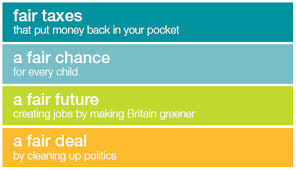
Furthermore, if we are to return to the tuition fee argument, how are tuition fees relevant to the topic of income tax thresholds? Answer; they’re not, but they are frequently referred to whenever a positive Lib Dem announcement is made. If the implication is that you can’t trust the policy due to the tuition fee record, then look at the front page of our 2010 manifesto:
1) Fair taxes: raising the income tax threshold to £10,500 (£500 above the 2010 limit)-delivered
2) A fair chance for every child: £2.5 billion a year pupil premium for the most disadvantaged primary school students-delivered
3) A fair future for making Britain greener: doubling the electricity generated from offshore wind and creating the world’s first Green Investment Bank-delivered
4)A fair deal by cleaning up politics-fixed term parliaments, so a Prime Minister can’t call an election on a whim-delivered
Don’t trust us on fees? Fine. But on income tax, alongside our key priorities on the front page of our manifesto, we have delivered.
No doubt we have been tribal at times, every party goes through that process. However, I’d like to think that our decision to enter a coalition with another party in 2010 was proof that we can put tribalism aside (and you can see on separate occasions in my blog that I have given due praise to both Ed Miliband and David Cameron), but that then leads to accusations of collusion with ‘the enemy’! I’m not sure what people were expecting of the Liberal Democrats at the autumn conference. They’re frequently slated for going into coalition with the Tories, so they made their distinct feelings on their partners pretty clear:
-Nick Clegg accused Theresa May of "playing party politics with national security. Stop playing on people's fears simply to try and get your own way. Your Communications Data Bill was disproportionate, disempowering - we blocked it once and we'd do it again."
-Clegg also said David Cameron's plans to renegotiate Britain's relationship with Europe would turn out to be "largely synthetic".
- Lib Dem president Tim Farron accused the Conservatives of being "borderline immoral" for trying to "balance the books on the back of the poor".
The inevitable retort to this is that the Lib Dems are hypocrites for attacking their own partners, but Clegg got it bang on when he said "we worked with the Tories because voters chose them as the largest party - not because we liked them, or because we are like them." The tribal attack in this context is a paradox; you can’t accuse the Lib Dems of being Tory clones, and then in the same breath accuse them of cynical politics when they differentiate themselves from the Tories in no uncertain terms.
So then, a summary of the policy announcements from the conference:
-Mr Clegg said the Lib Dems would cut income tax for 29 million people if they were in government after the election
-People with depression should begin "talking therapy" treatments within 18 weeks, from April.
-Business Secretary Vince Cable called for a "rebalance" of tax and spending cuts in order to eliminate the deficit
-Scottish Secretary Alistair Carmichael said further devolution of powers to Scotland would "unlock the progress to federalism across the whole of the United Kingdom”.
-Young people with psychosis for the first time will be seen within 14 days - the same target as cancer patients.
Once again, there’s nothing objectively wrong with these policies, and it’s a good message. It’s just whether people will listen to them, or want to listen. It’s our task as a party to get that message delivered.
*N.B. Certain quotes are taken from the BBC website; they have the relevant rights etc.
Subscribe to:
Posts (Atom)


.jpg)
.jpg)