Thursday, 29 January 2015

What is the Government doing to help young people in the Dales stay local?


It says something about our MP that even the leader of the Derbyshire Dales District Council, the Conservative Lewis Rose OBE, objects to an ill-considered government measure on affordable housing. A new threshold for central government planning (around 10 units or less) was announced on the 28th November, meaning that developers will have far less of an obligation to provide affordable housing across the district.

A recent Guardian article (found here: http://www.theguardian.com/society/2015/jan/13/affordable-rural-housing-new-threat) highlights how the reforms listed on the DDDC website will hurt the Dales (http://www.derbyshiredales.gov.uk/your-council/news-and-publications/latest-news/1849-policy-reforms-to-hit-future-affordable-housing-provision). I'll give credit to Lewis Rose for not simply toeing the party line. Indeed, if his quotes were ascribed to opposition leaders you wouldn't question the source: "they torpedoed our scheme (£1.2 million over 10 years to deliver more than 1,000 homes) at a stroke by an arbitrary change to planning rules...It came out of the blue. It meant that our whole affordable housing strategy was severely damaged. I was appalled".

The topic of affordable housing is a serious issue across the whole country, but in the Dales this comes back to a point I made when I was first selected as the Parliamentary Candidate for the Liberal Democrats; the area may superficially have an affluent image, but the reality is quite different. As a young person myself, affordable housing certainly seems a long way off, and I think I can say that the feeling is mutual for many young people across the area.

Some more credit to Lewis, as he has questioned Patrick McLoughlin on the issue, who was "taken aback because he realises the seriousness of the matter". The Guardian article notes that Patrick will be looking into it, but somehow I doubt that the status quo will be challenged. The Derbyshire Dales is a beautiful part of the world to live in, but I don't want it to be exclusive to a minority, or too expensive for the majority. The Dales is for young people, too.


Thursday, 8 January 2015

The NHS needs consensus, not weaponry


Along with the economy, the NHS is rightly seen as a top priority by the population of Britain. Simon Jenkins notes in Thatcher and Sons that even the Queen of privatisation, Mrs Thatcher, was “terrified” of touching the NHS. It’s a behemoth that politicians must pay lip service to, and any slight tampering is met with outcries. The controversial Health and Social Care Act of 2012 had to be “paused” after significant opposition, and is still viewed with suspicion today. Nevertheless, I am encouraged that, despite the tough economic decisions that have been made in this Parliament (and will continue to be made after 2015), the major parties have already pledged significant sums of money for the NHS post-2015. The Autumn Statement secured an extra £2bn of funding, and the Conservatives, Labour Party and Liberal Democrats all appear eager to meet the extra £8bn per year target by 2020, as set out in Simon Stevens’ Report (NHS Chief Executive). What is less encouraging is the political posturing that has taken place.

The recent A&E crisis is a serious concern, and it further underlines how vital extra cash is to the health service. However, Jane Merrick was right to point out in The Independent that “trying to profit from NHS misery” is cynical and unhelpful. She points out that Jeremy Hunt plays down problems in the NHS, whilst friends of Ed Miliband have noted that he wants to “weaponise” the NHS as an election issue. Each political party no doubt will argue in the coming months that it is best placed to handle the NHS, but as the health service is stretched and the A&E crisis escalates, patients and families who are affected do not need politicians utilising the crisis as an election tool, nor do they need triumphalism when the NHS enters calmer waters.

As crazy as this may sound to some voters, it’s also tricky to see the NHS argument as black and white. I have had many emails from constituents in the Derbyshire Dales asking whether I’d support a proposed ‘NHS Reinstatement Bill’, which would “reverse 25 years of marketisation in the National Health Service, abolish the purchaser-provider split, re-establish District Health Authorities and other public bodies and fully restore the NHS in England as an accountable public service”. I am sympathetic to this, and I do not like the idea of market principles creeping further into the NHS. I was very sceptical of the aforementioned Act of 2012, but I am pleased that the distinction of the NHS remaining “free at the point of use” has remained, and that the mandate is still there for the Health Secretary to provide such a service. I have offered broad support for the NHS Reinstatement Bill on the condition that other distinctions are clarified. I admit that this is not an unequivocal stance, but private involvement that is controlled and that can reduce waiting times and benefit patients is a good thing. Furthermore, as a Liberal Democrat I know the lesson of this Parliament of not making pledges that you can’t guarantee in the future.

I am set to take part in an NHS debate in March with my political opponents, and I very much hope that we attempt to reach a consensus on what is best for the NHS in the Derbyshire Dales, rather than having a slanging match which will benefit no one. The NHS should always remain free at the point of use, and as Jane Merrick puts it, “ministers and opposition politicians need to acknowledge that this crisis is a national emergency and try to reach consensus”.

Monday, 22 December 2014

Hopes (and fears) for 2015


The relatively short period of time between now and the 2015 General Election on May 7th was highlighted when the election campaign officially began on Friday 19th December. Polling day is just over four months away, and nobody can decisively predict the outcome.

I recently looked back at my 2011 prediction for 2015 (I did write back then that it was relatively premature to hazard a guess!): http://viewsfromthecentre-left.blogspot.co.uk/2011/10/2015-general-election-whos-going-to-win.html

It is clear that, over time, I have needed to significantly alter my estimate. I predicted a “comfortable, but not emphatic majority for Labour in 2015”, whilst wary that “events can change dramatically”. I also pondered the question “can victory be achieved under Ed Miliband?” The “comfortable, but not emphatic” victory is no longer my opinion, as the election is genuinely too close to call. Nevertheless, my questions for Ed Miliband remain the same today, that he “needs to present to the country a coherent strategy on dealing with the economy, but crucially he also needs to define what the Labour party are now”. Have these questions been answered? Put it this way; can you succinctly sum up Labour’s economic strategy? I certainly can’t. In terms of Labour’s identity, we’ve had Old Labour, New Labour, Blue Labour, predistribution Labour, One Nation Labour, with the latter three labels emerging within this Parliament! I also said that draining Liberal Democrat support wouldn’t be enough, and that appears to remain the case now.

I noted that the Conservatives needed an increase in growth and employment along with justification for their deficit reduction strategy to win in 2015. The Coalition has certainly delivered on the former; at the time of my October 2011 blog entry, 2.68 million people were unemployed compared to 1.96 million in October of this year, whilst UK growth returned to pre-recession levels in the second quarter of this year. However, with regards to justification for the deficit approach, the jury is still out; it has forced Labour to balance between renewal and ‘tough talk’ on spending cuts, but it also stands in a bad light in comparison to George Osborne’s original pledge to eliminate the deficit by 2015 (2018 is now the target). The Conservatives’ temptations to crudely imitate Ukip are well documented, and in Douglas Carswell and Mark Reckless they have already suffered defections to Nigel Farage’s party.

The challenges for the Liberal Democrats that I listed back in 2011 remain the same, that they need to shake off consistent unpopularity and receive justification for what they have achieved in the Coalition. Tuition fees are still used as a stick to beat the party with, but when you look at the context of 2010 and the record number of students in the present day, it doesn’t have to be as daunting an issue to face as it seems. On a local and personal level, I need to do my best to be a credible candidate for the Derbyshire Dales, to not only hold the Rt Hon. Patrick McLoughlin MP to account, but to also challenge the duopoly of Labour at County Council level and the Tories at District Council level. On a national level, I’m desperate to see the party raise the income tax threshold further. The personal allowance level will hit £10,600 in April, and with a Lib Dem presence in government it will rise to £12,500 over the next Parliament, with National Insurance thresholds aligned.

Interestingly, I made only one reference to Ukip in my 2011 blog predictions, which says much about how quickly and significantly they have barged into national politics over the last couple of years. This reference, nevertheless, holds true for 2015, although the ‘big three’ tag doesn’t apply anymore, as I noted “it is virtually impossible for other political parties to be in the running for the country in 2015, but they can all play an important role as the ‘big three’ try to win...UKIP can exploit strong anti-Europe sentiment and drain Tory support, whilst the Green Party can build on their 2010 success...as the ‘radical’ party”. Add the SNP to the mix to “damage the credibility of Labour”, and you have multi-party politics in action in 2015, and slim chances of having an overall majority. However well the likes of Ukip and company do in 2015, they are unlikely to have a fair reflection of seats from votes, so it is my hope (as ever) that electoral reform is back on the agenda post-2015.

Much has changed since late 2011, but whilst I have changed my overall prediction, the challenges listed for each party back then still apply, although fresh challenges have since emerged. My view now is that the performance of the party leaders in the spring of 2015 will shape the outcome of the election, with the TV debates once again key (rumoured to be in a 2-3-5 party format). For now, I predict a hung parliament, but I can’t guess who the largest party will be, nor can a multi-party coalition be ruled out.

Hopes for 2015

-Recognition of Liberal Democrat achievements in government, along with acknowledgement of blocked Tory agendas

-Higher scrutiny of Nigel Farage and Ukip as a whole

-Significant discrediting of Russell Brand’s “revolution-don’t vote” platform


Fears for 2015

-Liberal Democrat achievements from 2010 to fall on deaf and/or unwilling ears

-Ukip to continue to rise in the polls; imagine Nigel Farage as Deputy Prime Minister in 2015!

-Tribalism and populism to take over, with no room for compromise or sensible discussion


Merry Christmas everyone!

Thursday, 30 October 2014

The election that people have forgotten about…


There’s a significant event happening on Tuesday (4th November) which people (including me for a while) have forgotten about in the UK. No doubt it’s frequently on the airwaves in America, but with the Scottish independence referendum taking political centre stage in the UK amongst other world events, the US midterm elections haven’t been given much of a look in. They still may not be considered significant on election day, but the elections could have serious ramifications for President Obama and his presumptive successor, Hillary Clinton.

I remember quite a significant build up over here to the 2010 midterms, where the Republican Party seized control of the House of Representatives and eroded the ‘supermajority’ in the Senate. Barack Obama’s healthcare reforms had been controversial for many, and the experience led to the use of the term “shellacking” from Obama. Although the Democrats kept the Senate, it has meant that the Republicans have been frustrating in their obstructionist methods (remember the fiscal cliff?). Obama did extremely well to win the 2012 Presidential election in these circumstances, but he has still been hampered at many turns.

Worryingly (if you’re of a centrist or left-leaning disposition), forecasts predict that the GOP will not only retain the House, but also gain the Senate (http://www.theguardian.com/us-news/2014/oct/30/republicans-confident-midterm-success-america). The last two years of a Presidential cycle (in a second term) are often seen as the ‘lame duck’ years, but more so if an incumbent President’s party does not control either House of Congress. It seems crazy that a Republican Party so torn apart by in-fighting and soul searching (sound like the Tories at all?) could triumph on Tuesday, especially if you go by these economic figures during Obama’s reign:


Those figures were posted by a website entitled “The American Conservative”, no less. I admit that I’ve not kept as close an eye on US matters since 2012, but I still do rate Obama as a President. He’s not delivered in all areas, but he’s done remarkably well under electoral restraints. It seems the cynics are coming out in force now, just as they did in 2012, chiding Obama for not delivering the “change” and “yes we can” attitudes that were promised. The problem is, whilst these slogans served as good rhetoric, how can you possible measure them? Obama has ended “don’t ask, don’t tell”, drastically improved the economy (an unemployment rate of 5.9% presently versus a rate of 9.7% in January 2010) and achieved landmark healthcare reform. Without the Senate, Obama will be curtailed in efforts to go further on gun control.


Furthermore, should Hillary Clinton win the Presidency in 2016 for the Democrats (she’ll have the Democratic nomination in the bag if she chooses to run), her programme will also be curtailed. However well she does against the Republican nominee, how can she enact her plans if both the House and the Senate are Republican-run? They’ve already shown over the last 6 years that they are not capable of consensual politics, let alone giving consideration to the democratic mandate that a President possesses (mostly; think of the 2000 election!).


I very much hope that the Democrats do better than expected, but sadly the last two years of Obama’s presidency look set to be another lame-duck session. I would love the first black President to be followed by the first female President, and not for the sake of it; I think Hillary would make a great leader. The question is, what sort of plan for America will she put forward over the next two years, and will she be able to deliver it?

Thursday, 9 October 2014

A good message, but will people listen to it?


For me, the Liberal Democrat Conference in Glasgow ticked all the right boxes. We shouted about our achievements, laid out what we wanted to achieve in the next parliament, highlighted what a Tory or Labour majority government would do, and highlighted our differences from the Tories (that’s putting it mildy). The message from the conference was a good one, but will people listen to it?

As I’ve said many times before, tribalism frustrates me intensely. Can’t we objectively agree that raising the income tax threshold to £12,500 is a good idea, and that raising it to £10,500 in this parliament (£500 above our initial 2010 goal) is a solid achievement? Such calls are immediately met with “you can’t trust Nick Clegg/the Lib Dems on anything. Remember tuition fees?” Even a pledge to set waiting times for patients with mental health, a topic I’d hope would bring consensus and a measured debate, was met with an attack by Andy Burnam: “For over four years Nick Clegg has let mental health services slip backwards. Waiting times for talking therapies have got longer and people are struggling to get the support they need.”

Tweeting political stuff inevitably attracts argument and debate; it’s whether that debate has credence or not. Take an argument I had recently (go to @LibDemBen on Twitter if you want to see it for yourself), which began when I simply tweeted:
 

You may well argue that this was a tribal tweet in itself, but that’s nothing compared to the reply I got from a randomer:


We had a long debate, which to be fair was relatively sensible at times. However, I attempted to round up the argument by stating that it could drag on forever, so I finished with “let’s agree to disagree”. Here was the reply:


What does that add to the debate? Nothing. Another tribalist argument with only one goal in mind; to express disgust at the Lib Dems and to refuse to acknowledge any credit. This was just one Twitter argument, but I feel it highlights quite well the endemic tribalism that is present in many areas.

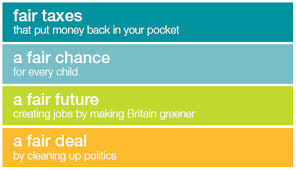
Furthermore, if we are to return to the tuition fee argument, how are tuition fees relevant to the topic of income tax thresholds? Answer; they’re not, but they are frequently referred to whenever a positive Lib Dem announcement is made. If the implication is that you can’t trust the policy due to the tuition fee record, then look at the front page of our 2010 manifesto:


1) Fair taxes: raising the income tax threshold to £10,500 (£500 above the 2010 limit)-delivered

2) A fair chance for every child: £2.5 billion a year pupil premium for the most disadvantaged primary school students-delivered

3) A fair future for making Britain greener: doubling the electricity generated from offshore wind and creating the world’s first Green Investment Bank-delivered

4)A fair deal by cleaning up politics-fixed term parliaments, so a Prime Minister can’t call an election on a whim-delivered


Don’t trust us on fees? Fine. But on income tax, alongside our key priorities on the front page of our manifesto, we have delivered.

No doubt we have been tribal at times, every party goes through that process. However, I’d like to think that our decision to enter a coalition with another party in 2010 was proof that we can put tribalism aside (and you can see on separate occasions in my blog that I have given due praise to both Ed Miliband and David Cameron), but that then leads to accusations of collusion with ‘the enemy’! I’m not sure what people were expecting of the Liberal Democrats at the autumn conference. They’re frequently slated for going into coalition with the Tories, so they made their distinct feelings on their partners pretty clear:

-Nick Clegg accused Theresa May of "playing party politics with national security. Stop playing on people's fears simply to try and get your own way. Your Communications Data Bill was disproportionate, disempowering - we blocked it once and we'd do it again."

-Clegg also said David Cameron's plans to renegotiate Britain's relationship with Europe would turn out to be "largely synthetic".

- Lib Dem president Tim Farron accused the Conservatives of being "borderline immoral" for trying to "balance the books on the back of the poor".

The inevitable retort to this is that the Lib Dems are hypocrites for attacking their own partners, but Clegg got it bang on when he said "we worked with the Tories because voters chose them as the largest party - not because we liked them, or because we are like them." The tribal attack in this context is a paradox; you can’t accuse the Lib Dems of being Tory clones, and then in the same breath accuse them of cynical politics when they differentiate themselves from the Tories in no uncertain terms.

So then, a summary of the policy announcements from the conference:

-Mr Clegg said the Lib Dems would cut income tax for 29 million people if they were in government after the election
-People with depression should begin "talking therapy" treatments within 18 weeks, from April.
-Business Secretary Vince Cable called for a "rebalance" of tax and spending cuts in order to eliminate the deficit
-Scottish Secretary Alistair Carmichael said further devolution of powers to Scotland would "unlock the progress to federalism across the whole of the United Kingdom”.
-Young people with psychosis for the first time will be seen within 14 days - the same target as cancer patients.

Once again, there’s nothing objectively wrong with these policies, and it’s a good message. It’s just whether people will listen to them, or want to listen. It’s our task as a party to get that message delivered.


*N.B. Certain quotes are taken from the BBC website; they have the relevant rights etc.

Friday, 19 September 2014

Relief for the Union, but time for devolution for the WHOLE of the UK

Early this morning, Scottish voters voted for the Union, much to my relief. In the end, the margin (55% v 45%) was more decisive than the polls had predicted. Admittedly, I had been one of those complacent commentators who assumed early on that Scotland would vote to stay in, but I was nevertheless cautiously optimistic that they would vote 'No' leading into polling day, although this was nothing more than a hunch. The three main parties have promised more devolution, and the optimist in me sees no reason why this pledge for more powers in Scotland won't be fulfilled. However, I'm strongly of the view that this should extend to all of the UK.

Firstly, what a triumph for democracy. BBC coverage of the referendum correctly stated that the independence campaign was proof that politics is not boring. Furthermore, voter turnout was nearly 84.5%, with people who hadn't been involved before (including 16 and 17 year olds) engaged and passionate on both sides. Compare the 84.5% figure with a voter turnout of 65.1% in the 2010 UK General Election, and you get a clear picture. The SNP had a democratic mandate for a referendum after their landslide win in the 2011 Scottish elections, although legitimate questions of whether the rest of the UK should have been allowed to vote in the referendum were raised. There appeared to be a paradox with the three main party leaders in their canvassing. On the one hand, it was refreshing to see them try their best to keep the Union together, yet this also played into the hands of Alex Salmond, who was able to portray them as "the Westminster elite". Nevertheless, it was the correct decision, and I believe it reflected a genuine concern from Cameron, Clegg and Miliband.
What seemed to be a lame duck campaign by Alex Salmond's side was reinvigorated after the second televised debate with Alastair Darling, more proof that you don't have to grimly accept polling figures (even if the final outcome was a negative one for the SNP).

Another hope from the referendum is that the rest of the UK will take a closer look at their fellow Union members. My knowledge of Scottish affairs is, I confess, still limited to an extent, but I feel the historical and political importance of the campaign forced me to improve my understanding somewhat. I can't profess to offer a detailed analysis, but with regards to issues such as currency, I will use an analogy that I have shared frequently; the SNP's approach appeared to be akin to someone who has cancelled their membership of a golf club, but nevertheless still demands to use the facilities. I cannot say for certain, but this may well have been the deciding factor for what Richard Nixon referred to years ago as the "silent majority". Gordon Brown's presence also appeared to galvanise the campaign with a speech filled with passion that I've rarely seen from the former Prime Minister, whilst I had huge respect for the resilience of Jim Murphy on his soapbox after having eggs thrown at him. Although Alastair Darling's performance in the second debate was poor, he was nevertheless an important figure for the No side, not to mention the many activists and members of other parties.

Wales and Northern Ireland will now, rightly, make calls for further powers, but I believe that the case needs to be made for other UK areas, too. Progress has been made, as I outlined in an article for the Matlock Mercury here: http://www.derbysdaleslibdem.org/#!lib-dems-devolution-achievements-vital-/c1f76 However, I have still heard people say that the recovery is only happening in the south. I don't think this is true, but it's a pertinent question, and there's no doubt that too much is centralised in the capital. I heard an interesting call for Manchester and Liverpool to be merged as a 'super city', and whilst this may be deemed controversial for some, it is the right approach, if not the right outcome. Devolved fiscal powers for regions like these is a must, and if we are to take the Scottish Independence referendum as a template, regions such as Yorkshire, Lancashire, Derbyshire and so on are similarly passionate about their counties (although I suspect that few of them want independence!).

The Great Recession was due to a result of many factors, but one factor was our over-reliance on financial services concentrated in London. It's too simplistic and naive to say that greater devolution would have protected the country from the banking crisis, but it certainly could have mitigated it. I fully support Michael Heseltine's review into localism, with the Government stating that the vast majority of his recommendations would be enacted: https://www.gov.uk/government/publications/governments-response-to-the-heseltine-review-into-economic-growth Evidently, advancements are being made with regards to devolution, but we need to "think big" on far more proposals. The Northern 'super city' idea is a step in the right direction, and it could be replicated in other regions. Whether it's true or not, we need to abolish in practice the "Westminster only cares about London" mantra.

And what now for the SNP? They have two years left before the next Scottish elections, and they do still have popular policies to present and defend to the Scottish voters, such as free prescriptions, no tuition fees and the abolition of trident. However, Alex Salmond (or will it be Nicola Sturgeon?) will have a far less rhetorical campaign message in 2016 now that the issue of Scottish Independence has been answered. The SNP will be licking their wounds somewhat, but a lot will still depend on whether the Scottish Labour Party can bounce back (much like the UK Labour Party).
Steve Richards, a chief political writer for The Independent, made a fascinating prediction on The Daily Politics recently. He suggested that if the Conservatives win the 2015 election, hold a referendum on the EU and vote to leave, the SNP would make renewed calls for a referendum on Independence and for staying in the EU. It's certainly food for thought, and the 45% 'Yes' figure is too large to be complacently disregarded.

I'm delighted that Scotland are staying in the Union, and I hope to see more devolution for them, Wales and Northern Ireland. However, others UK regions need similar advancements.

Wednesday, 10 September 2014

Scottish referendum: Setting the stage for the next debate

Scotland is just days away from an
historic decision on whether to leave Britain, but whatever the outcome, there may be wider ramifications for the future governance of the UK than some think, suggests guest blogger Charles Britten.


To begin, I would like to thank Ben for allowing me to be a guest blogger on his site. For the record, no other Liberal Democrat PPC has ever done likewise. Quite a first.

In true parliamentary style I should declare an interest by stating that I am not actually writing this blog from a centre-left perspective. But please don't let that put you off if you have logged on to read centre-left thoughts, for the issues I raise here will have widespread ramifications for the future of the United Kingdom. Plotting the way forward is a
question about which those of all shades of political opinion and none will have much to say.


Aye or Naw for Scotland?


It starts, however, with the dawning reality that Scotland does truly stand on the brink of departure; with different polls now showing each side in the lead the independence referendum may indeed be too close to call, with the yes side potentially gathering the momentum that will take them over the line.

This would have been inconceivable to most even a few months ago, but on two trips to Scotland this summer it was noticeable how much the mood had changed since my previous visit last year. In 2013, people I overheard discussing the issue only spoke of Mr Salmond's project to dismiss it.

Much has changed. Staying in Aviemore in late May I met, for the first time, the kind of person who has been increasingly prominent (mainly online) of late, the sort of nationalist who is more certain of everything than most people are about anything. After getting me to take a photo of him and his son and chatting in a friendly way, he asked me: "So, what will it be like coming up here when we're independent?" For him there was no if, no maybe, about it - just a stone cold certainty, backed with an assertion that "I don't believe what the opinion polls say" (Doubtless he believes at least one of them now).


It can be somewhat difficult to know what to say in such circumstances, whatever the temptation to reply: "Yes...and how will Hell freezing over affect the train times?" It was, for a start, hard to tell if he was genuinely curious about my emotional state, or whether couldn't resist a jibe aimed at any Englishman he came across.


I joked - or perhaps half-joked - that maybe I would need a passport in future, but Mr Certainty was having none of it. That was just "Tory propoganda", as I suspect he imagines everything is - even when Ed Miliband says he would probably have border posts too.


His hubris even extended to the date of independence, which he believed would take effect immediately, rather than by the SNPs hoped-for deadline of March 2016. No, he insisted, there would just be a bit of "tidying up" to do. Indeed, it seemed to me that had this gentleman not existed, he would have to have been made up - ideally for the benefit of the film industry, perhaps wandering the rubble-strewn streets of a post-apocalyptic city with a dustpan and brush for his own bit of tidying up.


Yet could he be right after all? In my second visit to Scotland this summer, during the Commonwealth Games, it was interesting to see far more Yes posters on display than No, particularly where I was staying in Edinburgh. This really was like being in a film, as the windows of some streets resembled the script of When Harry Met Sally.


Many of us had wondered if the Games would affect the referendum, as politicians love to play with sport when it suits them - and Mr Salmond has form for this, as seen by his Saltire-waving when Andy Murray won Wimbledon.


This was certainly a time for Scots to be proud of their team as they smashed their Games medal record, but that was not the whole story; Wales also recorded their highest ever tally, Northern Ireland had their finest Games since 1986 and England went and topped the whole table. Far from providing ammunition for independence, the Games showed one of the 'positive benefits' of the union the SNP claims don't exist - the impact of abundant UK-wide funding to develop our Olympic sports men and women into winners, whether for Team GB or their constituent nations in the Commonwealth Games.


Even with campaigning suspended, there was still much talk about the vote during the event. One lady told me on the train into Glasgow she would vote yes, even though she doubted they would win - and freely recognised how contentious the issue was. Also, it may fairly be noted that she did not share the hostility towards the English displayed by a hard-core minority of Scots, the sort for whom it is still socially acceptable to admit you like
Mel Gibson.


Her generosity even extended as far as handing this Englishman a spare hockey ticket, on the proviso that I supported Scotland in their match. That wasn't hard - they were playing Australia.


By now I knew exactly what was on offer from the SNP. On my earlier trip to Aviemore, someone had helpfully left a copy of the Scottish government's White Paper on Independence in the lounge, so while others went to bed I spent hours ploughing through it, or as much as it was possible to extract from the key chapters in a document that runs to over 500 pages. While it was as extraordinary in its optimism as its length, this prospectus demonstrated an extraordinary naivety that has sowed the seeds for a potentially nasty
divorce.


Currency Union? You're having a laugh


The currency union question was, and is, the most toxic. Many will wonder why Mr Salmond did not outline a plan B after the main three parties said they would not enter into such an arrangement. I suspect the answer can be found right there in the white paper. It stated unambiguously that there would be a Sterling currency union. Full stop. There was no statement that this was a 'preferred option', or that there would be negotiations aimed at agreeing a currency deal. It appeared never to have entered their thinking that there might be anyone opposed to this, or anything that could stop it. In other words, there just an assumption that it would happen.


Consequently, for Mr Salmond and co to outline a plan B would be to effectively admit that this overconfident statement was either absurdly complacent or extremely short-sighted. The SNP's own document has painted it into a corner. They are left with no choice but to claim their opponents - who are also their prospective negotiating partners - are
"bluffing".


This issue should also provide a reality check in response to the SNP's claim that the remaining UK would be an independent Scotland's new best friend. The economic case against a currency union is very strong, but the political one is impregnable.


What appears to have been forgotten by the nationalists is that the UK will go on without an independent Scotland, and in that UK there is a thing called public opinion. This shows a large majority back the refusal to enter a currency union. It is rapidly hardening against Scotland as the sense of rejection grows, and will give any remaining UK government a mandate to give Mr Salmond a rough ride in the negotiations.


Moreover, there is the specific political context to consider; the UK has a general election to hold less than a year from now. That may not bother the SNP much if Scotland has voted yes by then, but this is the backdrop against which the UK government must negotiate on behalf of England, Wales and Northern Ireland for the best deal in talks with a departing Scotland. The process would unquestionably be an election issue,
both in terms of a judgement on how the current government has started it, and how each party would propose via their manifestos to continue it. 


In such circumstances, it would be unthinkable for people who had argued against a Sterling currency union - particularly as they have done so on the same grounds that they have persistently argued against British
membership of the Euro - to suddenly accept it. And what party would dare break rank and be the first to do so, risking the wrath of public opinion and damaging their credibility?


Of course, Alex Salmond has only gone and brazenly claimed that after a yes vote the three main parties will all definitely, without question, change their tune on the currency question the
very next day. Yes, he actually wrote that in an article for the August edition of the Scotsman Magazine. But just imagine the consequences if that was true: It would mean opposing a currency union was a freely-available policy for another party to adopt while accusing the main parties of "selling out". In other words, it would be a perfect gift for UKIP. In short, a currency union would be bad economics and dire politics.


Spot the majority.


All these arguments can be avoided by a no vote. However, even in that event there can be little doubt that some change is coming. And it
will not be confined to the "devo max" announced by Gordon Brown that will increase the powers of the Scottish parliament.


The issue of who exercises power is, however, too hot a topic to pass over. A common refrain from nationalists is that Scotland tends not to get the government it votes for. In fact, in the past century that has not been true. Poorly-informed people
have claimed the Conservatives have never had a majority in Scotland, which is only true if you jump in a TARDIS and go back to the 19th century. In fact, the Conservatives did get a Scottish majority in 1900, 1931 and 1955, as well as the most votes - but fewer seats than Labour - in 1951 and 1959. 


Of the 25 general elections since 1910, nine have seen the
Scottish will outvoted by the rest, but that has also been the case in six instances in England, each where the biggest party was the Conservatives but a Labour government resulted. In addition to that, one could also say that while Scotland voted for a Labour majority in 2010, the English voted for a Conservative majority - so neither got what it had ultimately voted for. What the nationalists present as a clear-cut anomaly is far from that.


Indeed, matters get murkier the deeper one probes. Earlier this year, Cornish became an officially recognised nationality. Yet Cornwall has never elected more than one Labour MP and has often had Liberal / Liberal Democrat majorities, including a clean sweep as recently as 2001. So should they split on the basis of not often getting the government they want?


The list goes on: What of Wales, which unlike Scotland really has never had a Tory majority and has had a labour majority in every election from 1922 onwards? There, support for independence is very low, and even the 1997 devolution referendum only backed the assembly by a hair's breadth. And what of the areas that always vote Conservative but sometimes get Labour? Above all else, what if large parts of Scotland vote no but the majority votes yes? They won't even get to be in the country they want.


Other ways to reshape Britain?


For all that, the issue of the spreading of power to a more local level is a live one. It is no longer the subject of serious left-right disagreement. All parties now accept devolution and the use of city mayors has been championed by the current government - even if most of them could never enjoy the profile of someone like Boris Johnson in London.


Talking of the blonde one, Boris has stumbled into the debate in an intriguing way, railing against the idea of Scotland getting more powers as reward for a no vote and arguing that "instead" there should be more tax-raising powers for England's big cities.


His either-or line was unfortunate, for it was picked up on by the nationalists for propaganda purposes. However, the idea of
more local power for city regions is one worth considering. Perhaps that should be tried in Glasgow and Edinburgh too, rather than lumping all the eggs of tax powers in the Holyrood basket. After all, Glaswegians should, in any normal circumstances, enjoy an economic and reputational boost from the positive image created by the Commonwealth Games, just as Manchester did after 2002.


Talk of empowering regional English cities is significant. The accusation of Britain being geared up too much towards the interests of London and the south-east is not confined to Scotland, but it has been a popular nationalist campaigning tool, not least as the current 'toff' government has been seen as epitomising the preservation of such a situation.


However, to claim this - as so many do - is to perform a truly Orwellian piece of doublethink. The Scottish government's own white paper quoted a major political figure as stating that the UK economy is indeed too focused on London and the south, and this means action is needed to change that. The identity of this apparently staunch supporter of the SNPs argument? None other than David Cameron himself. You could not make it up.


In fact, it has been a clear and obvious feature of coalition government policy to shift wealth-creation away from a London-centric approach. Not everyone will agree it is being done in the best ways (HS2 being particularly contentious) and Labour has developed some ideas of its own on the matter, but the commitment is there.


As an example, George Osborne may be a southerner from a public school, but he is one of those for whom moving north - in his case, as the MP for Tatton in the shadow (or vapour trails) of Manchester Airport - has apparently been an epiphany. He said as much in a recent speech in Manchester where he talked about the importance of HS2 coming north to the city (as well as Leeds and Sheffield) and how a trans-Pennine HS3 may further help turn the big cities of the north combine their strengths to become a new economic "powerhouse", a counterbalance to London.


Of course, none of this interests the nationalists much, who claimed in the white paper - and this also isn't made up - that the UK government was neglecting the north of England by only taking HS2 to Manchester and Leeds. Sadly, I was bereft of a pen at the time of reading with which to add some observations in the margin.


The response from these apparently not very northern city regions has been to present Mr Osborne with a major new £16 billion transport and infrastructure plan for the region, with this enterprise representing a partnership across party lines as Liverpool's Labour mayor presented the blueprint to a Tory chancellor. Significantly, the plan for an area stretching over 100 miles from the west coast to the east also been devised without there being any kind of single northern regional authority in place to come up with such
ideas.


Having devolved English regions is an idea that has been championed in past Liberal Democrat manifestos (though not in 2010) and was toyed with by New Labour - until the North East, seen as most likely to accept this idea, gave it short shrift in its own referendum in 2004. This was immediately followed by the cancellation of other northern regional plebiscites
and the idea died quietly.


So if not English devolution, then what? If Scotland is being offered devo-max, the rest of the UK will be asking, quite reasonably, about what they are going to get. And it is this, whatever the outcome of the referendum, that means things will never quite be the same again.


In view of this, it will be necessary for a wide-ranging national conversation to take place about just what kind of roles the national, devolved and local government authorities should play in each part of Britain. Already the situation varies across the UK and creates some anomalies, like the West Lothian Question. But it is a conversation the country needs to have, not just in Scotland, but everywhere.


The chief aim of this should never be to shore up the power of the locally dominant political party, but to spread economic growth. It should seek to ensure, above anything else, that national efforts to secure and sustain the recovery are bolstered by local decision making that reflects the specific needs of each area.


A federal Britain is only one idea for doing this and some in Ben's party may still favour that, but as long as English regional devolution is off the agenda, alternatives need to be devised; perhaps through looser partnerships between neighbouring city regions, or simply more spending decisions being taken locally.

In summary, while working out how (and if) Scotland can fit into the UK, there are other pieces of the jigsaw we need to consider too, but without a one-size fits all approach. For like a real jigsaw they are very different in size, shape and other ways. When the dust has settled on the referendum, the question of just how, and to what extent, Britain should be decentralised will be our next national debate.