Monday, 11 May 2015

My Derbyshire Dales reflections


3,965 votes. I look on that figure with mixed feelings; sadness because we couldn’t reduce Patrick’s majority (and we came behind UKIP and Labour), but pride that such a significant amount of people backed the ‘New Deal for the Dales’ message. On what has been a very sobering election, I feel a sense of privilege.


I’ve had time to reflect on our campaign in the Dales, and I can honestly say that I wouldn’t change anything about our approach if I was given a TARDIS. Prior to my selection in 2014, the Derbyshire Dales Liberal Democrats didn’t have any social media channels; we not only changed that by building up hundreds of followers on Facebook and Twitter pages, but we revamped the local party website. I was able to get across our (and my) values on a regular basis through various video interviews, whilst getting these values across in person through good old fashioned canvassing. I had great responses from constituents with regards to the election leaflet. Whilst I’ve no doubt that there are many critics of it, the only people to come to me to criticise it were two Labour activists and a Conservative; they were hardly likely to praise it! I was always keen to stand up for young people, but I also felt immensely encouraged by fellow Christians, who appreciated that I was prepared to put my faith above the parapet, so to speak.


I felt saddened by the loss of so many talented MPs, and watching the swing against so many Liberal Democrats standing for election was excruciating. There was more of a stunned silence rather than ranting when we saw the exit poll at home. Whilst this may sound rather hollow, I did well to hold on to my deposit when half of Lib Dem parliamentary candidates lost theirs, whilst the swing against me in the Dales was lower than the swing against the national party. These are small crumbs of comfort, but for myself and many others not much could have been done to prevent the landslide against the Liberal Democrats nationally. On the lighter side of things, me and my family had the novelty of ordering a ‘Ben Fearn burger’ in Matlock, as all of the candidates had burgers named after them. It was certainly strange to hear my brother say “could I order six Ben Fearn burgers, please?”

It hasn’t always been plain sailing, and one door knocking session in particular got me down. One person asked who I was before I’d even approached them, and when I said which party I was with, brushed me off. When I said “well as long as you vote for someone”, they retorted with “you do realise that approach will cost you votes?” I couldn’t believe such a cynical attitude. Another constituent told me they had voted Lib Dem twice but wouldn’t ever again due to the Coalition; after they had slammed a tax cut (the personal allowance increase) which has benefited me and my family, we had the following exchange:

“Very well, would you be prepared to vote for us at a local level? Councillor Burfoot has done some excellent work…”

“I shall be voting Labour”

“Oh ok, which Labour councillor will you be voting for? What do you like about them?”

“.....I shall be voting Labour”.

Clearly, such political passion did not extend to local matters or concerns. Another constituent gave me this response:

“Hello, I’m the Parliamentary Candidate for the Derbyshire Dales. Have you kept up to date with the election?”

“No, but I won’t be voting for you (shuts door)”.

I hadn’t even said which party I was with! This exchange frustrated me as the person in question was the wife of a former teacher that I know of, so I had at least hoped for some sort of conversation based upon a shared context, even if it didn't result in a vote of support. The 7am declaration time at the election count also wasn't fun (we had arrived at around 11.30pm with no sleep), not to mention refreshing the Twitter feed on my mobile to see the loss of MP after MP (losing Vince Cable and Charles Kennedy especially hurt).

The five debates between myself, Patrick McLoughlin (Conservative), Andy Botham (Labour), Ian Wood (Green) and Amila Y’Mech (Humanity) have been lively affairs, and I’m pleased that two of them (Wirksworth and Ashbourne) have been recorded; I had publically called for screened debates in 2014. I felt very nervous before each one, but they are great for democracy, and the exchanges were passionate. I only wish that everyone in the constituency could somehow view them; I’m sure that a lot of orthodoxies would be challenged. I’ve been happy with my performance at each one, and I’ve had people approach me after each debate to congratulate me and to urge me to carry on, whether they were going to vote for me or not.


The groundswell of support has been incredible, from family and friends. I genuinely couldn’t have done it without them. The local party have been immensely supportive, whilst my local church (Darley Dale Hillside) and fellow Methodists have been greatly encouraging. Support mechanisms like these are crucial for sustaining you throughout an election campaign, especially one which for me started in January 2014. People have asked if I’ll stand again in 2020, when I’ll be at the grand old age of 27. This’ll be a politician’s answer, but I honestly can’t commit either way; a lot can happen in five years on a personal and national level. The idea of having the same candidate for two elections certainly appeals to me, as you can build up a base of trust and familiarity in that time, but we’ll see. What I can tell you is that I feel emboldened again to fight for liberal values, especially as membership in the party has gone up by over 7,000 since polling day, giving the Liberal Democrats over 50,000 members.

There’s hope for the future. Many people have said that, whilst not voting for me, they wish me the best and want me to keep at it. This encourages me just as much as people who say that they’ll vote for me, and I mean that. I only get frustrated if people refuse to give me a hearing simply because of my party banner. I’ll leave you with the words of a constituent who didn’t vote for me, but who wants me to continue:

“Dear Ben,

Although I did not vote for you, I want you to know how impressed I, and a number of people I have spoken to, are with your performance in the hustings.

Your enthusiasm, clarity, integrity, as well as your grasp of issues, have impressed us, to the extent that we want to encourage you to continue! We see a great future for you in politics, especially if can refrain from becoming part of the 'machine'.....

More power to your elbow.

The struggle continues”.

Tuesday, 5 May 2015

Vote for a New Deal for the Derbyshire Dales


We’re now just a matter of hours away from polling day. With my dedicated team, we’ve canvassed Matlock, Bakewell, Ashbourne and Baslow amongst other places, whilst my debates with the other candidates have taken me to Wirksworth, Eyam, Ashbourne, Bakewell and finally Matlock. Whatever the result on Thursday, I have discovered from this campaign just how well you can get through to people when you are committed to a passionate message.


I have been eager to highlight two points in my campaign; firstly, that I want a ‘New Deal for the Dales, and secondly that I want to encourage and involve young people. On the first point, I have unashamedly mimicked a political device used by President Franklin D. Roosevelt (FDR). FDR was a huge influence for me, and one of the historical figures that launched my interest in politics in the first place. However, the New Deal also represented strong and meaningful reform in the face of vested interests. I’m not demanding a ‘New Deal for the Dales’ purely for rhetorical devices; that New Deal means a better government grant for the Dales (we get one of the lowest grants in the UK), so that services aren’t cut back here so severely, and investment can be made in key areas (one area I highlighted at the debates is that of the much needed Ashbourne bypass). Furthermore, the New Deal that I want also entails better wages (the wages here are the lowest in all of Derbyshire). These statistics come from the Derbyshire Dales District Council Economic Plan, and who are we to doubt the Tory-run District Council, Mr McLoughlin?!


The second key point which I mentioned is young people. Less than half of 16-24 year olds voted at the last General Election, compared with over 70% of people aged 65 and over. Russell Brand urges people not to vote in order to change this, but you get change by voting for change. As long as there is this apathy, policies from the political parties will continue to be skewed towards the crudely named ‘grey vote’. Fortunately, I’ve had good responses both from our election leaflet which highlights this, and also young people from canvassing and email responses. It’s my strong hope that, by standing for Parliament at the tender age of 22, I can encourage other young people to get involved. From interactions with people, my age has been a positive, and has often been seen as a welcome departure from the status quo.


The debates have been lively, especially the last debate in Matlock. They are great for democracy, and it’s good to see passion from the constituents. Two of the debates have been recorded (Wirksworth and Ashbourne), so I’m glad that my calls last year for screened debates have been heeded to a large extent. However, it’s a great shame that the debates couldn’t somehow be viewed by every household in the constituency; I think certain orthodoxies and assumptions would be challenged. The line-up for all but one of the debates has been as follows: me, Patrick McLoughlin (Conservative, and running for re-election), Andy Botham (Labour), Ian Wood (Green) and Amila Y’Mech (Humanity); Irene Ratcliffe stepped in for Botham at Bakewell, whilst John Young (UKIP) also attended the Bakewell debate. The questions have certainly been varied; the Eyam debate had very specific local questions (one question asked what our party’s policies were on the lack of HGV drivers!), whilst the Ashbourne debate didn’t have any local questions at all (despite my reference to the bypass). The award for the most interesting question was definitely at Matlock; “if elected, which law would you repeal, and which law would you enact?” For the record, I said that I’d repeal the bedroom tax, whilst enshrining into law minimum spending (and appointment) requirements for mental health in the NHS.


I have felt hugely encouraged by responses from constituents (via phone calls, emails and face to face interactions) with regards to our election leaflet. The election leaflet is so crucial, as Royal Mail deliver it free of charge to every household in the constituency (some 41,500 homes). You can view it on my website (www.benfearn.com), but I was keen to outline the New Deal and youth message, along with our party’s record in government. With this leaflet, a strong social media presence and good old fashioned canvassing in the streets (all of these aspects are crucial), I think we as a local party have done ourselves proud to fight for our values.


To those undecided or otherwise, I leave you with this final message. I know this constituency is a safe seat, and I’m at the tender age of 22. However, it’s an absolute privilege to have this opportunity to represent the Derbyshire Dales. I want to challenge the status quo, and to not take votes for granted. I want to fight for the Derbyshire Dales; please fight for me.

Tuesday, 14 April 2015

Why I'm a Liberal Democrat


I became a Liberal Democrat in 2009, when I first took an interest in politics during my Sixth Form days. I knew about my own political heritage; my grandfather was a Liberal councillor in Matlock in the 1970s. However, I wanted to investigate for myself, and not just take my parent’s word for it. The Conservatives were miles away from my New Deal-influenced values, whilst the Labour Party seemed so incompetent and lacking in vision. When I saw a Lib Dem leaflet for the first time, I had mixed feelings; it was refreshing to see such progressive values, but I felt sad that these policies would never come to fruition.

That’s why I became a member in 2010; after the General Election. We had shaken up the old political duopoly, and we had the chance for the first time in generations to implement cherished policies, and I was determined to judge the party over 5 years, not 5 minutes. I’m proud of our links in Liberalism; the Gladstonian belief in free trade, the promotion of an active state to combat poverty by David Lloyd-George, the compassionate economics of John Maynard Keynes in challenging orthodoxies and a harsh ‘market knows best’ approach, and the building blocks for the NHS by William Beveridge. Of course the Liberal Democrats have slogans like any other party, such as “Stronger Economy, Fairer Society”. However, we have distinctive policies behind such slogans. “Fairer taxes” means paying no income tax on the first £10,000 that you earn (this has since gone up to £10,600, with a target of £12,500 by 2020); “a fair chance for every child” means a £2.5 billion a year pupil premium for the poorest primary school students, and “cleaning up politics” means having fixed term (5 year) Parliaments.

We have delivered on these policies; policies which I feel highlight the active role of Liberalism in helping those at the bottom. I am still a Liberal Democrat in 2015 because of this, but also because of the promise of more; prioritising mental health in our NHS, five green laws to protect the environment, an extension of free childcare and the raising of National Insurance thresholds in line with income tax thresholds.

I want to fight for this liberal and progressive vision. That’s why I attended an assessment centre in 2012 to become an approved parliamentary candidate, and I was officially selected as the parliamentary candidate in 2014 for my home constituency of the Derbyshire Dales. I know our party has made mistakes, and I know that we’re not hugely popular. However, I’m a Liberal Democrat because we have a promising vision for the future, backed up by concrete policies and not platitudes. We have a record of delivery and a promise of more. I couldn’t have imagined either of these things being possible in 2009, yet now it’s a reality. At the tender age of 22, that’s quite a vision to be inspired by, and to stand up for.


You can also view this blog entry on the "Why Join the Lib Dems" page: https://whyjointhelibdems.wordpress.com/

Monday, 13 April 2015

My reflections from the Wirksworth NHS debate


As I begin, I’d like to say that I was delighted with the turnout and reception at the NHS debate in Wirksworth on Friday 27th March. When we talk about engaging people in politics, such engagement was clearly on display on Friday night. I’m also not ashamed to say that I was very nervous prior to the debate! Nevertheless, a lot was at stake in the debate; a key battle for ideas.


I’ll briefly outline the format: The debate was hosted by Professor Andy Miller, and the panellists were as follows; myself, Patrick McLouglin (Conservative), Andy Botham (Labour) and Ian Wood (Green), with the UKIP candidate Jonathan Young not in attendance. None of the panellists knew the questions beforehand, and we were all permitted a response to each question from the chair, with points from the floor raised without responses or cross-examination allowed from the panelists (mostly!). Broadly speaking, the debate was in a two hour Question Time-style format, but with little cross-examination allowed between the panellists.


Based on questions both sent in and raised from the floor, the Health and Social Care of 2012 is very clearly a bone of contention for many people. I reiterated how I opposed it at the Gateshead Spring Conference in 2012, but that the amended bill had brought improvements. Crucially, the Health Secretary remains responsible, politically and legally, to providing a free at the point of use health service. I also emphasised how our party has committed ourselves to the £8bn a year of extra funding needed by 2020 (as outlined by NHS Chief Executive Simon Stevens), but also that we need to focus on how that money is spent. I highlighted mental health as a crucial priority, noting how it affects us all in some way, and that it must be given parity with physical health.


As expected, the frustration of the night was the holier-than-thou approach from the Labour candidate, Andy Botham. For most of the night, he was playing to the crowd whilst trying to conjure up a Red Flag spirit to the evening. Incredibly, when I pressed him, he said “yes Ben, I do want to ignore the deficit…” As I said at the event, the 2012 Health and Social Care Act did not introduce competition to the health service, and the issues facing the NHS aren’t black and white; the argument cannot be reduced to the private sector question. Conveniently, Botham ignored his party’s record on PFI schemes and the privatisation of Hinchingbrooke hospital in 2009; hardly socialist policies!


The final straw was when Botham finished off another diatribe with “we (the Labour Party) own it (the NHS)”. He stands for a style which I think has poisoned politics (and I said so); a petty, insular tribalism which demonises alternative viewpoints. I insisted “the NHS belongs to the people; it does not belong to the Labour Party”, which he never really responded to. I was fortunate enough to have the final say in the debate, and I outlined how we don’t have to choose between a strong economy and a strong NHS; the NHS needs cash, but cash that isn’t plucked out of thin air. As well as increasing spending on the NHS in line with a growing economy, we would pay for it through the following means:

-Capping pensions tax relief for the richest pensioners (saving £500m)
-Aligning dividend tax with income tax for those earning more than £150,000 (saving £400m)
-Scrapping the Conservative shares for rights scheme (saving £100m)

My final line was this: “An NHS for consensus, not weaponry”.


Patrick McLoughlin didn’t really say anything controversial or ridiculous, but at that point he didn’t commit to the £8bn touted figure (the Conservatives have since pledged to meet this). Ian Wood is no doubt a very clever man, and I admire his intellect. He was a confident public speaker, but I felt that he too often went off on tangents, and the debate itself spent too long debating the issues of TTIP (Transatlantic Trade and Investment Partnership), something which I firmly believe will have no impact on the NHS. Mr Wood’s approach would be brilliant for a lecture, but I got the impression that young people in the audience would have switched off.

I think the response from the audience was good in the end. The NHS is far too important to politicise, so it’s sad that Andy Botham was (and is) all too keen to do exactly that. I’d like to echo Nick Clegg’s words from the TV debate which followed this: “the NHS needs cash, not warm words...put your money where your heart is”.


You can watch the NHS debate in full on my website at www.benfearn.com

Friday, 3 April 2015

I cling to the hope of the Easter message


I noted to my friends and family recently that, purely in terms of days off, this will be the first Easter to be meaningful. I've enjoyed the benefit of being a student up until now, so whenever Easter weekend came around, I was already in holiday mode, so the bank holiday time off didn't really count. Certainly for many, this Easter weekend will merely serve a purpose of having more time in bed, or rest from work. It would be a great shame to completely miss the Easter message.

One of the biggest (if not the biggest) misconceptions about Christianity is that it requires ‘goodness’, or a set of works to be right with God. The Easter message is simple: the work has already been done, and not through anything we do, but by the immense sacrifice made by Jesus Christ. A friend of mine summed it up on a Facebook post recently:

“It’s not do, it has been done. Forget religion, find Jesus”.

It is an immensely powerful and hopeful message, and it is the challenge of believers around the world to not only grasp it, but to do their best to share it with others. Most people will be familiar, of course, with what happened, but true understanding is another thing. When I was a youngster at Sunday school, I always thought “why didn't he just save himself?” Surely it was in his capabilities to do so? This was also the thoughts of those witnessing the crucifixion: “come down from the cross and save yourself!” (Mark 15:29). This of course misses the point; it had to happen, and salvation wouldn't be possible without it. Jesus took the sins and punishment for everyone with his crucifixion; “it is finished”. Knowing the daily struggle of people, Jesus sympathised with this; the Son of God said “My soul is overwhelmed with sorrow to the point of death” (Matthew 26:38), and prayed for forgiveness for those who killed him; “Father, forgive them, for they do not know what they are doing” (Luke 23:34).

To many, this message is warm and fuzzy, but it surely could not have happened. This brings me on to my next point. Very broadly (and crudely) speaking, there appear to be two kinds of atheists in the world; those who are relaxed about church attendance and faith (provided that it doesn't interfere in their lives), and those who actively want to undermine faith in all its forms. There are of course countless examples of pretty awful actions and quotations from so-called believers, but this can lead to the dangerous assumption that all atheists are of a calm and rational disposition. I still can’t get my head around this awful quote from Richard Dawkins:

“I was asked what I thought about the widely publicized cases of sexual abuse by Catholic priests in Ireland. I replied that, horrible as sexual abuse no doubt was, the damage was arguably less than the long-term psychological damage inflicted by bringing the child up Catholic in the first place”.

There you have it. Dawkins thinks that one of the most heinous acts possible is subordinate to raising a child with faith. Fellow atheist Steven Weinberg adds a totalitarian flavour to proceedings with the following words:

“The world needs to wake up from the long nightmare of religion...Anything we scientists can do to weaken the hold of religion should be done, and may in fact be our greatest contribution to civilization”.


What are the implications of “anything we scientists can do”? This may seem like I'm going off on a tangent, but I'm trying to emphasise how it saddens me that some people would be so eager and zealous to undermine such a positive and hopeful message, even to the extent of equating child abuse to a ‘lesser evil’ than faith.

What about the evidence? John C. Lennox provides a compelling case in a book which I have referenced here before, “Gunning for God: Why the new atheists are missing the target”, and I urge you to read his account. In short, Lennox lists the sheer number of New Testament manuscripts (over 5,000), making it “by far the best-attested document from the ancient world”, and therefore a provision for historical context and accuracy. Also, how did Jesus’ followers go from being in utter despair at their leader’s death (who they abandoned, by the way!) to bravely proclaim Jesus’ resurrection to the world? If Jesus did not rise from the dead, what motivation would this band of flaky followers have had to preach the resurrection, knowing full well that doing so would result in their incarceration and ultimate death (which it did result in)? I'm not doing the case total justice here, but it’s certainly food for thought.

Yes, I'm a liberal, and no, I don’t believe in a watered down “Jesus was just a good guy” position of faith. I cling to the hope of the cross knowing that it has the power to save people like me who screw up too much. I hope that, in some way, I can spread this message through what I do as a Parliamentary Candidate, and I very much hope that I don’t shy away from it. You will have noticed that I haven’t really linked in a political theme to this blog post, but that’s because this topic is of great importance to me, and it is part of who I am. I have a duty to be honest about this with the electorate.


Matthew 28:20: “And surely I am with you always, to the very end of the age”.

Thursday, 2 April 2015

Why hung parliaments may become commonplace in Britain

Britain looks like heading for another hung parliament - and even with the first-past-the-post electoral system in place, that could be a very familiar outcome in the years ahead, writes guest blogger Charles Britten.

For the second time I have to thank Ben for allowing me to guest on this blog, with the disclaimer that the post is not necessarily written from a centre-left perspective, along with the counterbalancing point that those of a centre-left disposition should, I hope, find it as interesting as anyone else.

My previous post, in early September, had considered the implications of a yes vote in the Scottish referendum, along with the prediction that the debate on future constitutional arrangements would soon spread across the UK. That was not a particularly prescient view; it would have been more surprising had the debate not emerged. How that pans out may depend much on the composition of the next parliament, a matter of huge uncertainty just now.

With campaigning underway, it appears increasingly likely that the upcoming election will deliver another hung parliament, but with a different third party holding the balance of power. The Liberal Democrats have paid a high price for going into government, losing the support of two key parts of its voter base. The first is among people who would hitherto consider them a safe haven for a protest vote, rather than a party who would get their hands dirty by taking the tough and sometimes unpopular decisions that come from being in office.

The party has also lost support from those floating voters who incline to the left without always voting for Labour, leaving most of its support mainly confined to a core base. Notwithstanding the possibility that those pesky 'shy voters' - identified by pollsters as forever inconveniently distorting their figures - may now include some Liberal Democrat supporters, the only question is just how much of its parliamentary strength the party will retain this time round.

All that on its own might have made the 2015 election more likely to produce an outright majority, had the lost votes simply switched to the two biggest parties. Instead, a far more complex situation has arisen. By no means have all the left-leaning former Liberal Democrat voters gone over to Labour. This has in turn contributed to the rise in support for the Greens and the SNP, the latter bolstered further by Labour's startling decline in Scotland.

Without these developments, the basic consequences of the loss of Liberal Democrat support would be that a few of their seats would fall to Labour and many more to the Conservatives, but even a small swing from Conservative to Labour would see the latter regain plenty of marginal seats, propelling Ed Miliband into office. Now, however, the surge in SNP support as it pledges to provide a 'second best' solution for frustrated yes voters looks like scuppering Labour hopes for a majority.

The conclusion some might draw from this is that a second successive hung parliament would be incidental, since the main cause of it this time would be different to that of five years ago.

However, that would be short-sighted, overlooking the long-term gradual decline in the share of the popular vote enjoyed by the two main parties. In 1992 - an election that looked like producing a hung parliament until the actual ballots were counted - the polls had placed Labour and the Conservatives neck-and-neck at just under 40 per cent. Now, reaching 35 per cent is a struggle for them both. Even the present SNP phenomenon is not unique; while it is now eating into Labour's central belt strongholds, it should be noted the Nationalist heartlands in the north-east of Scotland used to be strong Conservative territory.

All this has arisen from a process familiar to psephologists: that of partisan dealignment. For many years after 1945 the safe assumption was that the working class voted Labour and the middle class was Conservative. However, at that time the working class was more numerous. This could have meant perpetual Labour government, but, on average, only two thirds of this demographic voted Labour, whereas four-fifths of the middle class voted Conservative.

This imbalance in class-based loyalties produced an overall balance in support and a two-party system was sustained - with the caveat that a small minority would still support other parties and did so enough in the remote Celtic fringes to maintain a tiny Liberal parliamentary presence.

Since the 1960s, however, class-based voting has waned. Of course, this has made it possible for one of the two main parties to snatch the initiative, win big majorities and rule for many years; For instance, Margaret Thatcher's council house sales in the 1980s helped attract votes from aspirant working class people who saw home ownership as their ticket to upward social mobility.

Similarly, After four successive defeats, Labour twigged that rather than trying to get the working class to be more loyal to it, the circle was more easily squared by a pitch to the middle class, which proved more willing to switch allegiance than would once have been the case. Thus New Labour's electoral success was a product of strategically exploited partisan dealignment.

However, the triumphs of Thatcher and Blair partially disguised the extent to which the smaller parties were growing in strength and significance from the 1970s onwards. The Liberals and their Alliance and Liberal Democrat successors were not alone in providing an alternative. If in the minds of voters they represented a slightly nebulous concept of simply being 'something else', the nationalist parties offered a clearer alternative to class loyalties: that of national allegiance, laced with concepts of suppressed identity and other grievances. UKIP is now doing essentially the same thing, with the distinction being that they see Brussels, rather than Westminster (that popular SNP euphemism for perfidious Albion), as the bogeyman.

The two elections of 1974 demonstrated that these were very much two sides of the same coin, with the Liberal surge in support and the rise of the nationalist parties - the SNP took 30.4 per cent of the Scottish vote in the October election - happening at the same time. Thus it would be incorrect to conclude that the rise of the SNP since 2010, the increasing support for UKIP and the Greens, and the successes of the Liberal Democrats over the 13 years up to that point are unrelated. All derive from a common decline in electoral loyalty to the main two parties, which has been manifested in different ways.

Consequently, it is reasonable to conclude the once unfamiliar phenomenon of hung parliaments may now become a regular feature of British politics.

To some, that brings into question whether the current electoral system is obsolete, given that it is supposedly 'designed for two parties', yet now features a multi-party system. Certainly those advocating first-past-the post (FPTP) on the grounds that it usually delivers majority government appear set for disappointment again - and I know Ben will be among those suggesting the weakening of this argument strengthens the case for electoral reform. ( http://viewsfromthecentre-left.blogspot.co.uk/2011/11/electoral-reform.html )

In asking whether hung Parliaments are likely to be the norm, however, it is important to start by remembering that there have been two referendums of major constitutional importance since 2010. While the Scottish referendum was close, the result of the choice between retaining first-past-the-post and switching to the alternative vote (AV) was not. At the very least, the case for electoral reform suffered a damaging reverse. That is not to say it will never return as a major issue, but for the foreseeable future it makes more sense to consider what elections under FPTP will look like.

When analysing what may happen, we are not confined to the realm of speculation, for electoral systems of all kinds can produce results they were not 'designed' to; after all, there is a certain irony in one referendum being held as a result of a coalition formed in the wake of an hung parliament under FPTP, while another came about because an election held under a proportional system - for the Scottish Parliament in 2012 - gave one party a majority.

The reality of FPTP is that it was not - at least in Britain - designed to produce a particular kind of party system at all. Until the end of the 1990s British electoral law did not even recognise the party system. It is incidental that it may produce a system of alternating, two-party majority government. Indeed, it often does not - without the system being abandoned as a result.

To demonstrate this, consider the highly varied experiences of other countries using FPTP. On the one hand, the United States with its Republican and Democrat parties is a prime example of an established two-party system. By contrast, in neighbouring Canada - which uses a system based on the Westminster model - there have been 18 general elections since 1865 that have not produced a majority.

These Canadian results include almost half of the elections since 1945 and has occurred in a political landscape in which three-party and even four-party politics have been the norm, while party names and compositions have regularly changed as splits and mergers have abounded. So common are such outcomes that they are commonly termed "minority parliaments", a more neutral term than "hung parliaments".

Other FPTP electoral outcomes include countries where one party dominates, such as Botswana, or dramatically changing fortunes like those in India, the world's largest democracy.

The former is an instance of a support base sticking loyally with one party (The Botswana Democratic Party), which, as explained above, is exactly the sort of thing that could have happened in post-war Britain had Labour achieved more loyalty from British working class voters. In Botswana, this has delivered victory for the ruling party in all 11 elections since independence in 1969.

In India's case, the first 40 years after Independence were also manifested by a dominant party system, as Congress won every election bar that of 1977. However, things changed dramatically from 1988. The rise of the Hindu Nationalist BJP did not create a real two party system as might have been supposed, because their emergence coincided with a wider fragmentation of the party system. A host of smaller and regional parties won large numbers of seats between them time and again - and the result of this was nine successive hung parliaments.

The landslide victory of the BJP and its electoral pact allies last year ended that sequence, but so badly beaten was Congress that this might be the start of another dominant party period. That remains to be seen, but the fact remains the history of Indian elections has been that of two utterly contrasting situations, both at odds with the supposed two-party norm of FPTP.  

So then, what of Britain? Would the emergence now of a political landscape where single-party majority government was the exception rather than the rule be unprecedented? Certainly not.

If the British 'norm' is of alternation between Labour and Conservative majority governments, then it is one that has only applied to a 60-year period encompassing the general elections of 1945 and 2005 and those in between (before 1945, there had never been such a thing as a Labour majority government). In this period 16 out of 17 elections produced a majority. The exception was February 1974, along with the additional caveats that the Labour government of 1974-79 and Conservative administration of 1992-97 lost their majorities through by-elections and defections during those parliaments.  

However, what of British politics before 1945? How about the 60 years before Labour's first majority victory? And what about the period before that?

If we go back to the time before 1885 - if not 60 years, then at least 53, to the Great Reform Act of 1832 - we see another time when a two-party system was the norm, with Whig/Liberal or Tory majority governments, once again, just one hung parliament (1847) interrupted the sequence.

However, the 60 years between 1885 and 1945 was different again. The first development was the rise of the Irish Nationalists, consistently securing over 80 seats in what is now mainly the Republic. This took some seats away from the Conservatives and many more from the Liberals. The arithmetic of this made it inevitable hung parliaments would happen, a situation the SNP could be repeating now.

This soon had knock-on effects. In 1885 the Liberals fell just short of a majority, sought Nationalist support with a home-rule bill and split over the issue, as the Liberal Unionist party emerged and joined an alliance with the Conservatives.

Their partnership worked rather like the Liberal-SDP Alliance, except this one managed to win elections. Thus while the polls of 1886, 1895 and 1900 did not produce hung parliaments, they also did not produce one-party majorities, as the Conservatives alone had less than half the seats but were comfortably in charge thanks to the scores of Liberal Unionists sat alongside them in the house. The two parties remained separate until merging in 1912.

However, there still were more hung parliaments during these years: The two-party unionist alliance could not gain a majority in 1892 and that led to another Liberal minority government being formed, again with Nationalist support. The same happened in both the January and December 1910 elections, with the added feature of over 40 Labour MPs. Indeed, in the eight elections from 1885 to the first world war, the only single party majority came in the 1906 Liberal landslide. Even then their strength was bolstered through an electoral pact with the fledgling Labour Party in England and Wales.

War brought the first coalition governments, as the minority Liberal administration joined forces with the Conservatives in 1915. This arrangement was replaced in 1916 with a second coalition when Lloyd George ousted Asquith, producing an arguably fatal split in the Liberal Party that continued through the 1918 election, in which a Liberal Prime minister issued a letter of endorsement - known as the coupon - to a field of candidates that included far more Conservatives than members of his own party. This was to be the first of two inter-war governments with a Tory majority but a prime minister from another party - or fragment of it; the same was true when Ramsay Macdonald and his 'National Labour' party held just a handful of seats after 1931, when the national government he formed amid the onset of the Great Depression split the Labour party and ushered in a Conservative landslide - even though the resulting cabinet included both National Labour and Liberal ministers.

The Liberal split between Lloyd George and Asquith aided the rise of Labour and while 1922 and 1924 brought Conservative majorities, the election needlessly called in 1923 brought another hung parliament, a genuine three-party split with the (newly reunited) Liberals coming third on 158 seats. Labour, on second with 191, formed the first of two minority governments with Liberal support. The second, from 1929, occurred with 59 Liberal MPs and a similar arithmetical outcome to 2010, except with Labour as the largest party.

With the 1935 election producing a continuation of the national government (only with a Conservative prime minister), it was another world war that brought about a second grand coalition (1940-45), with Winston Churchill and Clement Attlee sitting around the same cabinet table.

So it was that during the 60 years from 1885 to 1945, majority one-party government was the exception, not the rule, with six hung parliaments, four coalitions and three two-party alliances. Only the Liberals from 1906-10 and the Conservative governments of 1922-23 and 1924-29 were single-party majority administrations in the post-1945 (or pre-1885) sense.

Of course, it is true that any overview of this period would be incomplete if it did not note that electoral reform became a popular cause for many during the inter-war years (particularly the Liberals as the party declined), that the single transferable vote was experimented with in the multi-member university seats at general elections between 1918 and 1945, and that the Labour government of 1929-31 was prepared to introduce AV before it fell.  

Be that as it may, what this analysis shows is that even an electoral system under which two elongated periods of two-party politics have occurred can be subject to fragmentation, uncertainty and change, with governments of various different compositions emerging. Whether it is the changing party system, a period of three-party politics (in terms of seats and not just votes) or strong nationalist / regionalist parties (the latter often being a factor in the Indian and Canadian situations too), the historical lesson is that the two-party model cannot be taken for granted.

This historic lesson tells us that a post-2005 period of multi-party politics may indeed be upon us. And while the coming election may not bring much cheer for Ben and his Liberal Democrat colleagues, the fluid, unpredictable electoral landscape means there remains a significant possibility that, even under FPTP, they will get another taste of coalition government - or influence over a minority administration - before too long.

Friday, 13 March 2015

Yes, I agree with Nick (mostly)


No, you didn't misread the headline. Nick Clegg has made some big mistakes, and I've not been afraid to criticise him, be it the tuition fee pledge/vote or the increase in VAT. However, if anything my opinion of him has improved recently, and I have a new-found sense of respect for him.

I'll be frank in saying that after our crushing losses as a party in May 2014 (the local and European elections), I was tempted to call for Clegg to go. Our party base appeared to be eroding faster and faster, with little electoral reward in return. Such a move would have been a knee-jerk reaction, especially when you consider the wider context (which we as a general public don't always do). For starters, in 2010 there was no popular alternative option to take. A coalition with Labour? The numbers didn't add up for a start, a multi-party coalition including the likes of Plaid Cymru and the SNP would have been needed (sound familiar?), and do you really like the thought of Gordon Brown plodding on as Prime Minister? Even if a leadership election had been held, there would have been a good couple of months of an 'interim Prime Minister', and when the leadership election concluded we'd have had another Prime Minister who hadn't had an electoral mandate. Furthermore, documented accounts from the likes of Andrew Rawnsley (The End of the Party) and Adam Boulton (Hung Together) make it quite clear that Labour didn't really fancy doing a deal, as the latter notes:

"At least half the Labour side, and the dominant, elected side at that - Harman, Balls and Miliband - did not have their hearts set on reaching a deal" (p.233).

The point of this illustration is that Labour accusations of "selling out" to the Tories appear strange when Labour weren't keen on a deal either. So how about another option; go with no one? We could have trumpeted the 'principled' line for a while, but we'd never be seen as a potential party of government. A minority Tory government would have struggled along until a second election, where they most likely would have won a majority. Would we get praise for letting that happen? I sincerely doubt it.

Clegg made key errors in the early stages of this Parliament. You could understand him wanting to show the Coalition working, but he appeared too close to David Cameron, and was too naive to think that the Conservatives wouldn't get heavily involved in campaigning against the Alternative Vote (the Labour Party hardly helped, either). However, he deserves far more credit than he is getting. In 2012 he publicly made an apology for the tuition fee fiasco. This may sound a little pathetic on paper, but how often do politicians actually apologise for a specific policy error? Furthermore, despite Ed Miliband's bravado about David Cameron running scared of the TV debates (which he is, nevertheless), Nick Clegg was the only leader with the guts to take on Nigel Farage during the European elections, and it was Clegg who made the challenge in the first place. We've been reduced to 1 MEP, but I'm proud that we had a positive message for staying in the EU, rather than a bitter infighting Tory brand or a fence-sitting Labour pledge. Clegg also takes a weekly radio phone in on LBC radio, which again should not be understated. Could you imagine David Cameron doing that? Or Ed Miliband?

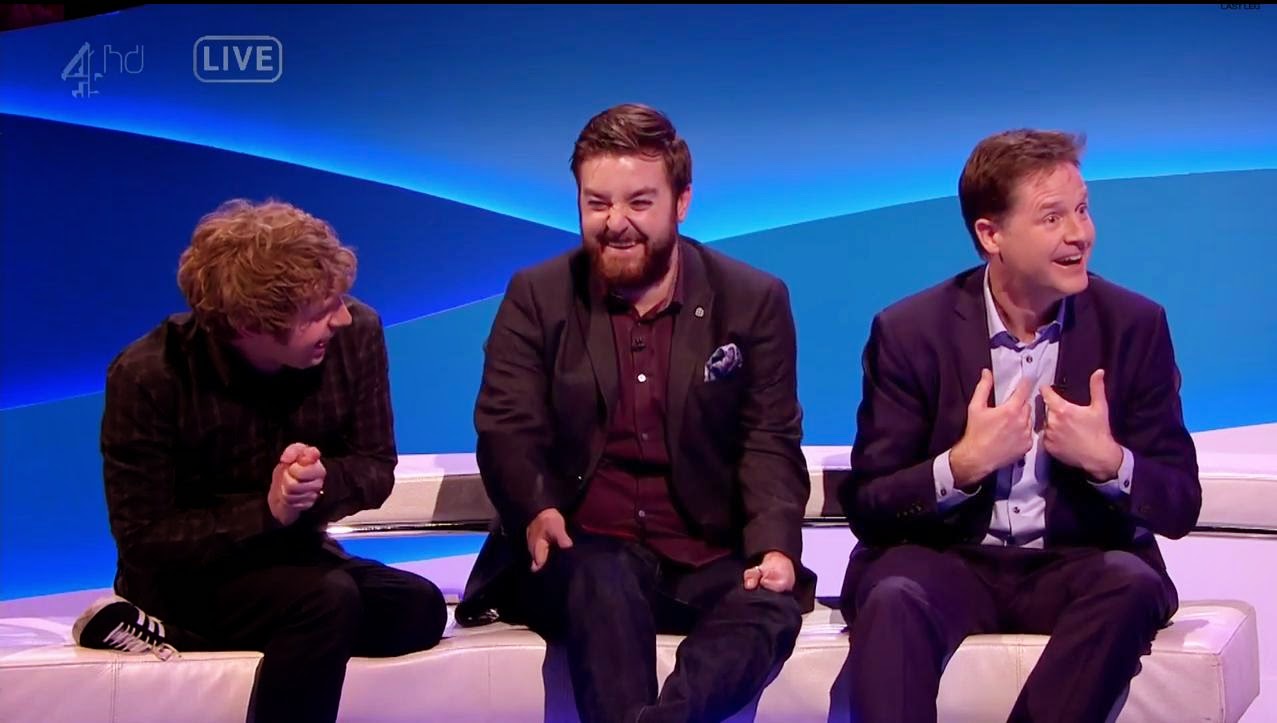
Nick Clegg was also a sport for going on the comedy programme "The Last Leg", where "the unthinkable happened"  (in the words of host Adam Hills) and Nick Clegg "did well. Really well.  I mean, really, really well". When Clegg was challenged to provide Alex Brooker with a solid reason for voting, he pulled out this humorous yet brilliant analogy: “if you go to Nando’s and get someone else to go up to the counter and order for you, you can’t complain if they come back with a meal you don’t want.” Once again, can you picture Cameron or Miliband going on the show? I'll extend it further and ask if you could possibly imagine Natalie Bennett appearing comfortable in the studio? I've not forgotten Farage, but for all his confidence I can't imagine him winning anyone over.

Nick Clegg call for pluralism when he was first elected Liberal Democrat leader in 2007, and he should be admired for tackling petty tribalism. If the Labour Party failed to form the next government but were able to take Sheffield Hallam off Nick Clegg, you can imagine that they'd celebrate like they'd won a landslide. Clegg should also be commended for the (broad) stability of government. How many people, especially on the Left, predicted the downfall of the Coalition in the early years? Even the more generous commentators presumed that it would break up in 2014 or early 2015, yet here we are. For the sake of the economy and the markets, it is a good thing that we'd had a government with a comfortable (combined) majority for a fixed-term Parliament.

It's popular to caricature and bash Clegg, but the people who do so rarely come up with a plausible or realistic alternative. Again, the dissenting voices on the Left would do well to expect a Green Party predicted to have 1 to 3 (at best) MPs to turn around and demand that the largest party in May reverse all economic cuts, bring in a Citizen's Income which would cost more than twice the NHS budget and aim for a zero-growth economy. The reasons for hating Clegg are often clichéd, too; "he broke his promise on tuition fees". Implicit in that is that you should hate Clegg for breaking a promise; using this logic, you should hate pretty much every politician (which I'm sure many do, but Clegg seems to bear the brunt of most of it). How about another one: "he sold out to the Tories". I'm pretty sure that getting the main policies from the front page of your manifesto into government for the first time in generations isn't selling out. I'm no lovestruck cheerleader for Nick Clegg, but I'm not ashamed to give him credit where it is due, and he is due a lot of it.